





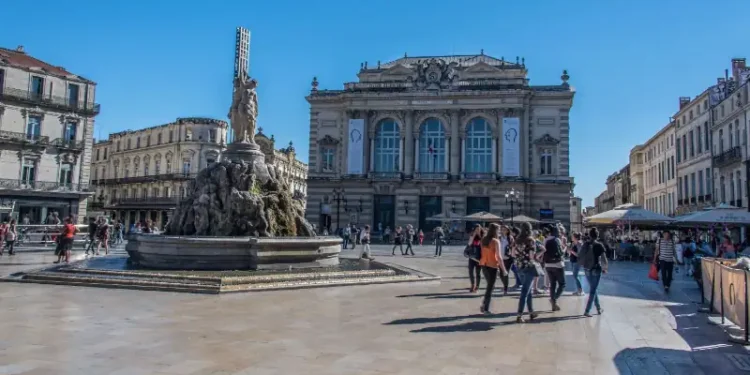
I recently sat down with Dennelle Taylor Nizoux, an American expat who has been living in Montpellier for 15 years now.
This university city offers a superb, laid-back lifestyle, culture, great connectivity, year-round sunshine, and mild seasons—without the big price tag of places like Nice or Paris.
Dennelle founded Renestance real estate services in 2015, and has since helped countless international buyers navigate the French property market and get settled in the region.
I was eager for her to share her insider knowledge: what it’s really like to buy here, what surprises people, what ideal costs look like, who really belongs in Montpellier—and who doesn’t…
Kat: Let’s start with your story—how did you end up in Montpellier?
Dennelle: I was a student in Provence in college, so I got to know a little bit of the south of France and the Mediterranean area.
By coincidence, his best friend from Normandy moved to Montpellier in 2001. We would take the train down to visit him, and he and his wife had their first baby the same year we had ours.
We kept going down to visit them, and every time we had to take the TGV back to Paris, it just got harder and harder to leave Montpellier.
The more we saw of Montpellier, the more we liked the vibe. It’s low-key, easygoing, open-minded, and has an indoor-outdoor lifestyle. I was born and raised in Southern California, and it felt a bit like home.
We were living the grind in Paris with two small children, doing the métro, boulot, dodo (metro, work, sleep), as they say. It felt like living to work, whereas our friends in Montpellier got off work at 5 p.m., grabbed the kids, a bottle of rosé, and headed to the beach to enjoy life.
I thought, “This is what I want.”
We moved down here in 2010 with our kids, who are grown now.
Kat: For somebody who’s never been to Montpellier, how would you describe it as a city for living?
Dennelle: It ticks a lot of boxes.
It’s walkable; you don’t need to get in the car for everything. We’ve got five tram lines that are free for residents.
It’s also near the beach—only about 10 kilometers (6 miles) away.
There’s lots of hiking and easy access to nature. Within 20 or 30 minutes of downtown, you could be hiking in the hills or mountains.
It’s also a very young, dynamic city because of the universities, and that brings a lot of culture.
We have a lot of artists and writers, and anybody who’s attracted to the arts can usually find what they’re looking for in Montpellier. We even have two opera houses.
It’s a very well-rounded city, but also, as they say in French, à taille humaine—human scale. It’s still manageable. I think it’s around 500,000 people now, including the metropolitan area. So it doesn’t feel too big, but it still has everything you might be looking for.
Kat: Right, as a university town, would you say that students are the main demographic? Is this also a city where French people tend to retire, or is retirement more concentrated in the villages around Montpellier?
Dennelle: Yes, there’s definitely a population of retirees here.
During Covid we had a lot of Parisians and French people from colder or less favorable climates come down to Montpellier because they could work remotely. There have always been people who wanted to retire to the south of France within France, but now we also have more remote workers here.
I think the villages can be attractive to retirees, particularly areas outside Montpellier—more countryside locations around places like Béziers.
You can get more for your money, and you’re not reliant on the job market.
Kat: You’ve experienced different parts of France, and I’m curious about your husband’s perspective since he’s from Normandy. Was there ever a pull to go north instead of south?
Obviously, the weather is the biggest difference, but aside from that was that ever a debate between the two of you?
Dennelle: He was perfectly fine with the weather in Paris—it was similar to what he grew up with.
But once we started spending more time in Montpellier, he really saw the appeal of being able to be outside most of the year.
We actually kept our apartment in Paris for probably the first 10 years we were in Montpellier because we weren’t sure if we were going to stay.
But pretty quickly, we both realized that waking up and seeing a blue sky every day changes everything.
Honestly, I think he was probably sold on it faster than I was.
Kat: All right, let’s get into the property market. We’ve talked a bit about the lifestyle and who fits in this city.
You’ve been working in real estate down here for how long now?
Dennelle: Almost a decade now…
I started Renestance as a full-service relocation agency officially in 2015, and then I got my degree in real estate and immobilier in 2017. We’ve been dedicated buyer’s agents since 2017.
Kat: And you’ve been on the ground here for so long, you’ve seen how the market has changed… So, what is the market like right now?
Dennelle: Well, Montpellier has been one of the fastest—if not the fastest—growing cities in France for at least 20 years.
It was already growing quickly when we moved down here.
And, like I said, there was a bump during Covid, when a lot of people came because they could work remotely, so growth has been steady.
In terms of price per square meter, Montpellier is still about half the price of Nice and some of the other destinations in the south of France, while offering many of the same advantages in terms of climate and lifestyle.
It’s also a fantastic travel hub.
Property values have appreciated steadily over time, and with good reason.
Bonne route,