




Repositioned now to Paris to enjoy the holidays with our children and granddaughters who call the City of Light home, I’m reminded why this is my favorite place on Earth.
Central historic Paris is an open-air museum.
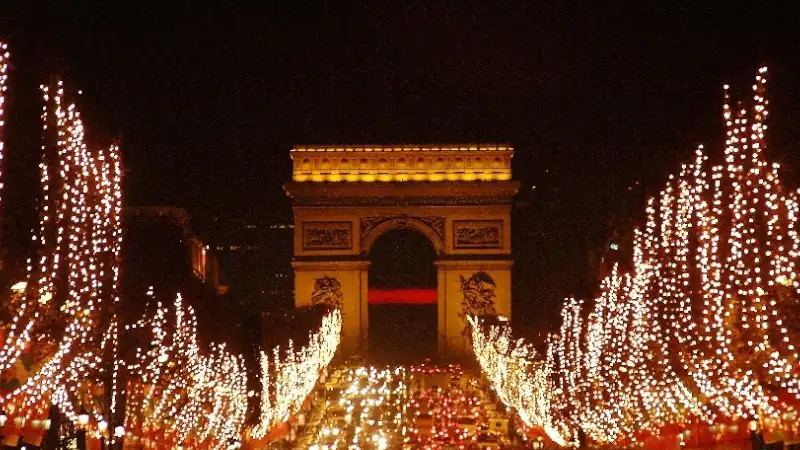
The heart of the City of Light is a never-ending feast for your heart, your mind, your body, and your soul… especially this time of year when every street corner and shop window is adorned with white lights and overhung with evergreen boughs and big red bows.
Café afternoons and Michelin-starred nights… gallery openings and museum exhibitions… seasonal celebrations and markets… bookstores and antique shops… luxury brands and farmers’ bests… fashion weeks and dance clubs… conversation groups and cooking classes… live theater… live music… movie cinemas showing first-run and foreign flicks (in English)… an active artist community… specialty food shops… spas and salons…
All in a setting of architectural delights and historic landmarks, grand gardens and well-tended parks.
Hands down, no contest, for my money, Paris is the best place in the world to seek out a life filled day-to-day with beauty and discovery.
“Where did the money come from to create all of this?” I once asked a Parisian architect friend.
“France has always been serious about collecting tax revenues,” François told me.
“Starting in the 16th century and continuing until the French Revolution, the country took a privatized, entrepreneurial approach,” he continued.
François went on to explain how, starting in the 1500s, France farmed out tax collection to private individuals who bid for the privilege.
In exchange for their concessions, these citizen tax collectors paid fees to the king. Whatever each collected beyond the fee he’d agreed with the crown was his to keep.
As the country and its population grew, each collector found he was unable to cover his entire territory effectively alone and so farmed out pieces of it to subcontractors, creating, over these centuries, a tax-collection Amway.
For a time—until Louis XVI and his wife found out what happened when the tax monies stopped flowing—both the tax collectors at the tops of these pyramids and the king himself amassed abundances of capital, some of the greatest fortunes of Europe for the period.
We won’t concern ourselves now with how these folks, both the citizen collectors and the kings they collected for, got their gains but with what they did with them.
They set out, each, to build ever-bigger, ever-grander homes, palaces, parks, and monuments.
It was a golden age of construction, when much of what today is considered the heart of classic historic Paris was conceived and commissioned. This was when the Louvre became the place we recognize today and when as many as 2,000 hôtels particuliers were built. These private mansions were the town houses of the country’s richest folks, each keen to show the others how much he was worth. About 500 hôtels particuliers remain standing today.
All this construction required skilled labor, and the most skilled labor of the time from across Europe came to Paris. The best craftsmen of the age made their way to the French capital knowing that there they would be paid top dollar to ply and perfect their trades. They worked over more than two centuries to build the Paris of the 1st through 8th arrondissements, the soul of the City of Light. These architects, cabinetmakers, and stonemasons created a stage that remains unrivaled.
I’m no fan of taxation, but I appreciate the legacy those tax francs from centuries ago have left us.
Specifically, what do I enjoy most when at home here?
If I had to make a short list of my favorite places to visit during the Paris Christmas season, this’d be it…
#1: Notre-Dame de Paris
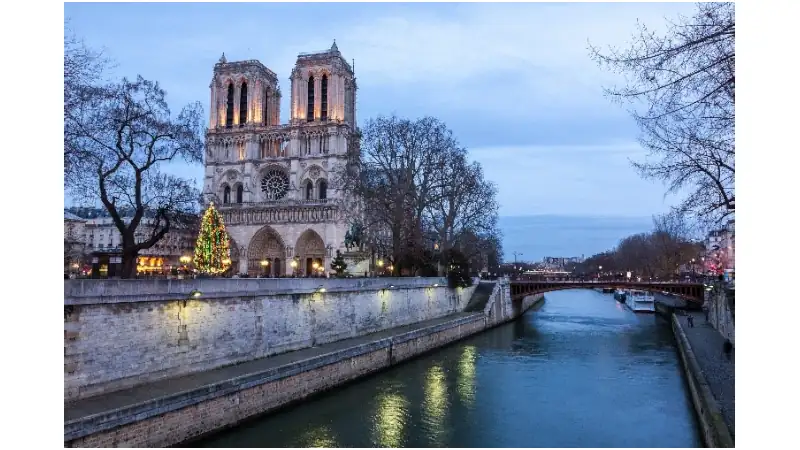
Our Lady of Paris Cathedral is on everyone’s top-sights-in-Paris list. You should see this iconic Gothic church from the parvis in front, you should tour inside, and you should climb the 387 stone steps of the narrow staircase to appreciate the structure’s famous gargoyles up close.
However, my favorite way to see Notre-Dame is from behind. Travel the Quai de la Tournelle to the Pont de l’Archevêché then turn around and look across the Seine for the most romantic perspective of one of history’s greatest architectural achievements.
My favorite Notre-Dame experience, though, is cathedral-adjacent.
I’m speaking of a picnic on the Square du Vert-Galant.
Some of my best Sunday afternoons in Paris have been spent on a blanket in this little park with friends, a bottle of champagne, a loaf of baguette, a wheel of brie, and Notre-Dame just skips away.
Notre-Dame underwent an extensive restoration following the 2019 fire and reopened a year ago this month. I saw the inside of the renovated cathedral for the first time over the summer. It’s everything it always was but lighter and brighter. Its limestone blocks gleam now like new…
#2: Musée Carnavalet
My pick for best museum in Paris, Carnavalet is a museum on Paris. Occupying two mansions in the Marais district, the Hôtel Carnavalet and the former Hôtel Le Peletier de Saint-Fargeau, it’s not only what’s housed in these 100 rooms, it’s also the rooms themselves that are worth seeing. This is an architectural and an historic treasure that also feels like a decorator’s show house, showing off the best of art and interior design from the 17th to the 20th centuries.
Allow time to enjoy the gardens, too, as well as the surrounding neighborhood, which is lively and fully dressed for the season this time of year.
Should you be in the city as a new expat rather than a tourist, note that the best place in Paris to shop for white china is just down the street from the Carnavalet. You’ll find La Vaissellerie at 92 rue Saint-Antoine.
Bonus trivia: While most Paris museums have free days every week or month, admission to the permanent exhibits of the Carnavalet is free every day. I’m hoping to make time to see the current temporary exhibit “People of Paris, 1926-1936” focused on the people who called the city home during the interwar years. Tickets for this special event are 15 euros.
#3: Place des Vosges
This is the oldest planned square in Paris, the first formal development in history, and the prototype of all European city squares to come.
If you appreciate classic architecture like I do, you’ll delight in an afternoon stroll beneath the vaulted arcades of the Place des Vosges.
When we first moved to Paris, I would meet a dear friend, the same Parisian architect who educated me on the history of taxation in France, here often. We’d take a table outside at La Place Royale, sip champagne, and watch the passing Parisian show.
#4: The Louvre And Its Gardens
If you plan to tour the Louvre, engage a private guide. This is one of the world’s biggest museums, displaying 70,000 works of art across 650,000 square feet of gallery space.
It’s also the most trafficked museum in the world, receiving 8.8 million visitors annually. Some hot summer afternoons it will feel as though all 8.8 million are in the museum with you. Time your visit carefully and, again, invest in a guide who can lead you through these grand halls efficiently.
Or skip a tour of the Louvre and opt for a walk from its central square courtyard through the triumphal Arc du Carrousel then on through Queen Catherine de’ Medici’s Jardin des Tuileries.
From the Tuileries you can carry on straight to Place de la Concorde (where Louis XVI was “chopped,” as my son, 4 years old when we moved to Paris, put it) then, if your legs are up for it, continue down the avenue des Champs-Élysées all the way to the city’s better-known triumphal arch, the Arc de Triomphe de l’Étoile.
When I was living and working in Paris for the first time two decades ago, my daily commute took me through the Tuileries gardens. In every season, the walk was the highlight of my day. In spring, children float sailboats in the ponds. In summer, tourists sip champagne in the open-air cafés. In autumn, the ground is carpeted with the leaves that fall from the allées of shade trees.
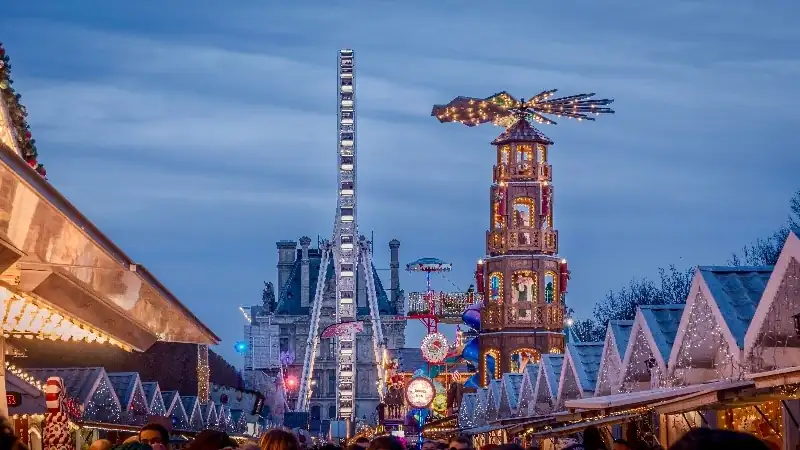
Then, come December, the Tuileries is host to the largest and liveliest Christmas market in Paris…
#5: Shakespeare and Company
Two of my favorite things are classic architecture and books. Paris excels in both categories.
The best place in Paris to shop for English-language books is Smith & Son on rue de Rivoli. When we lived here, my children and I would make a Sunday afternoon of an outing to Smith & Son monthly.
I’d say, though, that the best place to experience books is Shakespeare and Company, the iconic bookstore on Paris’ Left Bank originally opened by American expat Sylvia Beach. The store closed during World War II and was restarted in its current incarnation in 1951 by George Whitman, whose daughter Sylvia (named after Beach) runs things today.
Generations of writers have found a Paris home in what is likely the most famous independent bookstore in the world thanks to Ernest Hemingway who made his love for the place plain in his ode to Paris that he called “A Moveable Feast.”
Bonus trivia: Paris’ Kilometer Zero sits right across the Seine in the courtyard of Notre-Dame, but Shakespeare often commandeers the term, even using it on their merchandise, as Kilometer Zero was also the name of a literary journal the book shop once published. I’m headed over this afternoon to do some Christmas shopping.
#6: Café Louis-Philippe
In a city where it’s tough to name a favorite restaurant, this would be mine. Situated opposite the Île Saint-Louis on the Quai de l’Hôtel-de-Ville in the southern corner of the Marais, just at the end of Pont Louis-Philippe from which the place takes its name, this is a typically Parisian bar-restaurant offering traditional French cuisine. Choose a table upstairs and try the frog legs Provençal or stuffed tomatoes with goat cheese to start followed by boeuf bourguignon. It’s the best in the city and wonderfully warming on a cold December afternoon.
#7: Moulin Rouge
Touristy and tacky were the two words that used to come first to mind when someone would mention the Moulin Rouge. Then, last summer, a friend invited me to see the show. It’s a great night out. Yes, touristy… but not tacky.
The wait staff does an excellent job managing the big crowds. The food was better than you’d expect given the context, dinner comes with a bottle of champagne, and the show was almost Vegas-worthy.
Most memorable for me was the near-naked lady swimming around inside the water-filled clear acrylic box on stage with a boa twice her size.
The can-can was fun, too.
Even if you don’t spring for dinner and a show at the Moulin Rouge (it’s not a cheap date), take the metro to this part of town to experience Paris’ bawdy, racy side.
This is the neighborhood Toulouse-Lautrec made famous with his posters of the local working girls. Today it feels more like Greenwich Village than a red-light district.
When we’re at home in Paris, it’s also from where I write. Our little Paris operation is based here in Paris’ city on the hill.
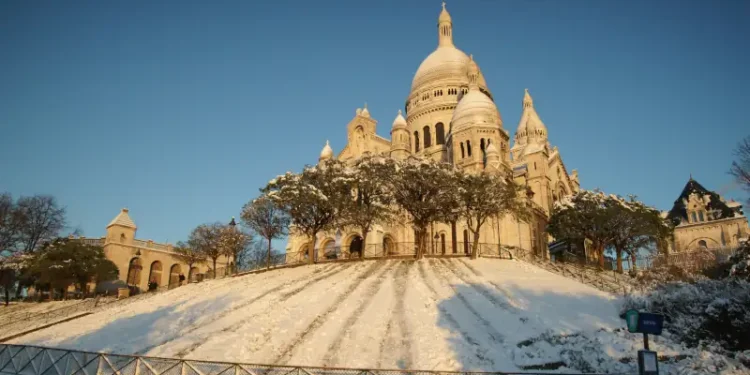
Right now, Montmartre, like all the rest of this magical city, is bedecked and illuminated for the season…
Until next time,

Kathleen Peddicord
Founding Publisher, Overseas Opportunity Letter