





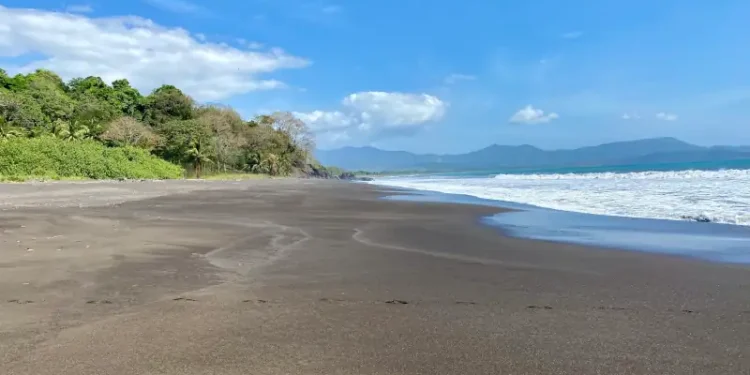
With both Pacific and Caribbean coastlines, marine life is just as rich. Dolphins, rays, and countless other species can be spotted year-round, while whales make a seasonal appearance along Panama’s coasts.
Even in the city, it’s not uncommon to see stingrays and pufferfish on your morning runs along the Cinta Costera or Amador. In fact, it’s become a sort of social media trend as of late to spot the crocodiles (locally known as a Juancho or, a drilococo if you want to sound hip and be in with the kids) in the coastal areas of the city.
Back on the Veraguas Coast at Los Islotes, residents are no strangers to Panama’s biodiversity. They get to experience nature’s wonders on a daily basis. Whether that be hearing howler monkeys while you’re taking a shower or bird watching in your own backyard… there’s always something to marvel at when you happen to be in this neck of the woods.
This is especially true every summer, when something extraordinary happens along the shores, and for the Los Islotes community, a quiet miracle unfolds right before their eyes…
Inside Turtle Season
Between the months of July and March, dozens of turtles hatch on the Pacific shores, making their big debut into the world. It’s one of those must-see, bucket list experiences that not everyone gets to witness, but those who do, remember it for a lifetime…
The Veraguas Coast is home to some of the most common, and also some of the most endangered species of turtles. These include the olive ridley turtle, the green turtle, the hawksbill turtle, and the leatherback turtle which is currently in critical danger—there have been no recorded sightings in the Pacific region for over 12 years.
Their absence is a powerful reminder of how fragile these ecosystems can be and how important it is to protect the ones that remain.
That’s why Los Islotes is committed to protecting as many baby turtles as possible, teaming up with local conservationists to patrol the beaches, protect nests, and educate people to ensure the preservation of wildlife in the area.
Besides monetary donations, our team at Los Islotes donates their time. Each small intervention becomes part of something much larger… an ongoing effort to ensure these ancient travelers continue their journey for generations to come.
Conservation In Action
During “turtle season,” Project Manager, Dalys De Gracia, starts her day bright and early walking along the Los Islotes beaches on the lookout for any tracks left by turtles that may have come ashore overnight.
The biologists from Fundación Agua y Tierra have instructed her and the rest of the Los Islotes team how to carefully extract any eggs they might find from the sand with precision and care. They then place them in containers, and transport them to the foundation as quickly as possible, within no more than four hours since retrieval.
Every nest rescued is then delivered to a protected hatchery, where it is labeled and monitored to track its incubation period which usually ranges between 30 to 45 days. The controlled environments increase the chances of survival, shielding the eggs from predators, flooding, and other environmental threats.
Thanks to these efforts, Fundación Agua y Tierra has achieved an impressive 80% success rate.
The Turtles’ Critical Voyage
Once the incubation period is over and the turtles hatch, the time finally comes for their release back on the beach.
The hatchlings are placed gently on the sand, where they instinctively begin their journey toward the ocean. Human interference is kept to a minimum, allowing them to find their way naturally. The team’s role is simply to stand watch, offering quiet protection when needed against opportunistic predators.
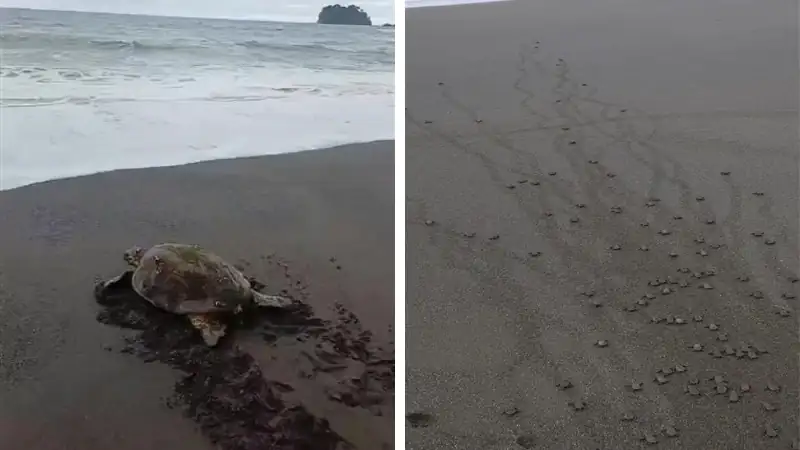
From that point on, their movement is driven entirely by instinct. Some head straight toward the water, while others take longer paths across the sand, adjusting to the slope of the beach and the pull of the ocean. It’s a brief but critical moment in their survival, where timing and environment play a key role in whether they reach the sea.
The turtles’ trek to the ocean helps them imprint the area, increasing the likelihood that years from now, they will return to the very same shore to nest.
Witnessing this process in person is heartwarming to say the least… and it’s hard not to draw parallels. Much like moving abroad, their journey is a step into something new… filled with curiosity, courage, and the promise of what lies ahead. As they make their way to the ocean, you can’t help but feel a sense of pride and excitement for what’s to come.
While the Los Islotes team’s role focuses on identifying and transferring nests from the beaches, Fundación Agua y Tierra carries out a more extensive conservation effort, including nighttime patrols along Mataoscura beaches to locate and protect additional nests.
Protecting sea turtles is not just about preserving wildlife. It’s about maintaining the balance of marine ecosystems and ensuring that future generations can continue to witness these remarkable journeys.
Join Our Conservation Efforts
At Los Islotes, that commitment is part of a larger vision—one shaped by Kathleen Peddicord and Lief Simon’s desire to create a place where both people and nature can thrive for generations.
If you’d like to be part of this mission… protecting endangered turtles, preserving nesting beaches, and giving every hatchling a fighting chance, take a look at how you can help Fundación Agua y Tierra here.
Sincerely