






Merry (one-week-from) Christmas!
When December rolls in across Europe, the holidays bring not only sparkling lights and carols—they also uncover a whole world of folkloric strangeness.
Beyond the well-known scenes of nativity sets and Santa Claus, many European regions preserve deeply weird, often humorous rituals that feel like little snapshots of cultural history.
From pooping logs to horned demons, these traditions remind us that the festive season has always had a playful (and sometimes dark) edge.
Here’s a beginner’s guide to some of the wackiest but most enduring traditions across the Continent…
Catalonia’s Defecating Figures: The Caganer And Tió De Nadal
Perhaps no European Christmas tradition is as cheeky—literally—as the caganer in Catalonia.
Hidden in virtually every nativity scene in this part of Spain, you’ll find there is a tiny figure of a man (or sometimes woman) squatting with pants down, doing his business. It sounds bizarre, but it’s a long-standing folk symbol with deep roots… the caganer figure (the “crapper”) is thought to symbolize humility (even the sacred nativity scene has a human who “goes about his business”), fertility, good luck, a touch of rural humor, and a hopeful wish for prosperity in the coming year.
From early December, children “feed” the log scraps of food, and cover it with a blanket to keep it warm. Then on Christmas Eve, they beat it with sticks while singing traditional songs to make it “poop” out treats like candy and little presents.
The tradition is more than just silly fun—it’s considered a ritual of joy, shared laughter, and family bonding.
Krampus, Knecht Ruprecht, And Winter’s Dark Companions
Not all European holiday figures bring gifts…
In Austria, Germany, Slovenia, and parts of the Alpine region, Krampus, a horned, furry demon, roams the streets around Dec. 5 (Krampusnacht).
Rather than rewarding good children, he punishes the naughty with chains, bells, or simply the terror of his presence.
Then there’s Knecht Ruprecht, Saint Nicholas’s sinister companion in Germanic folklore, a grim figure who carries a sack and a stick, checking whether children have behaved. In some stories, Ruprecht will bring coal instead of gifts, or even threaten those who haven’t been nice.
These dark companions are not just for scaring kids, they’re rooted in pagan winter-mask traditions, reminding us that many Christmas customs evolved from older, more chaotic rituals tied to winter’s uncertainty.
Witching And Gift‑Bringing: La Befana And Epiphany Magic
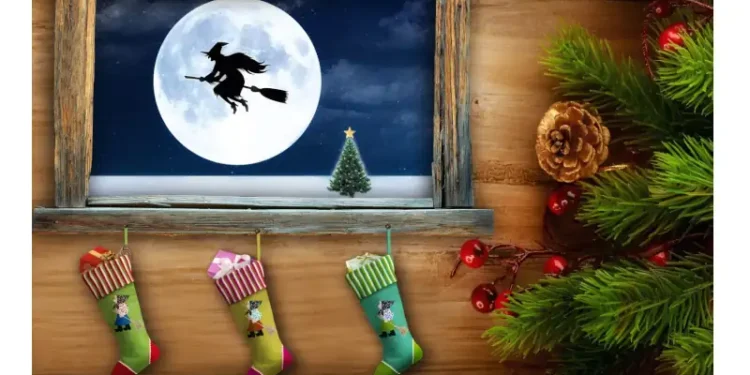
In Italy, the festive season doesn’t end on Dec. 25, it stretches all the way to Jan. 6, the Epiphany. On the eve of Epiphany, children eagerly await La Befana, an old witch who flies on her broom, delivering sweets to well-behaved children and coal (or dark candy) for the naughty.
Legend has it that La Befana once refused to follow the Magi to Bethlehem, and now spends her nights flying around, searching for the Christ Child, dropping off goodies (or lumps of coal), while sometimes cleaning homes as she goes.
Her story has grown so beloved that towns in Italy hold parades, festivals, and even burn effigies of her in public celebrations.
Julebukking And The Yule Goat: Northern Masquerades
In the colder reaches of Scandinavia, some of the most surprising winter customs don’t involve religious icons, but costumes and mischief.
On the days between Christmas and New Year, many participate in Julebukking, where people dress in masks, weird outfits, or straw goat costumes, then go door to door, singing, joking, and demanding treats.
This tradition shares roots with older pagan rituals and folkloric celebrations of midwinter.
In fact, the Yule Goat (Julbocken) itself has been part of Scandinavian lore for centuries, originally linked to pagan harvest rites.
Today, straw goats are common decorations—and don’t be surprised if you hear pranksters place one on a neighbor’s doorstep just for fun.
The Lord Of Misrule, Wassailing, And New Year Chaos
Some European winter traditions lean into chaos, inversion, and wild revelry rather than quiet piety. The idea of the Lord of Misrule—a person (or in some places, a symbolic figure) who leads raucous holiday celebrations—comes from medieval celebrations of carnival and Saturnalia.
During his reign, rules are turned upside down: servants may temporarily rule over masters, revelers make mischief, and normal order is comically disrupted.
In parts of the UK, so-called wassailing involves groups going out to orchards, singing to the trees to “wake” them and encourage a fruitful next season.
In such rituals, it’s believed that singing to the trees and sharing toast or cider draws good spirits and luck for the year ahead.
Across the Irish Sea, on St. Stephen’s Day (Dec. 26), another curious tradition unfolds: Wren Day, sometimes called “Hunt the Wren Day.” Traditionally, small groups of “Wren Boys” dressed in straw hats, masks, and old clothes would parade through towns carrying a dead wren (once real, now often a stuffed one) on a decorated staff with holly, ivy, and ribbons.
These Wren Boys go door to door, singing, dancing, and playing fiddles, tin whistles, and drums, collecting donations of food, drink, or money.
Parading the wren was thought to bring good luck for the year ahead, and that the bird itself had a mystical importance—in old lore, the wren was called the “king of the birds.”
In modern times, the practice has softened but remains alive in pockets of Ireland. While the wren is no longer actually hunted, the symbolic parade continues. Wren Boys march through the streets, local communities host small celebrations, and funds raised often go toward charitable causes.
It’s a blend of Celtic paganism, Christian ritual, and communal joy.
Superstitions And New Year Rituals
The turn of the year brings its own set of weird and wonderful traditions…
In Spain, especially Catalonia, the presence of the caganer in nativity scenes isn’t just for laughs, some believe he brings fertility and good fortune for the new year.
Meanwhile, in parts of Europe, people hold rituals or follow superstitions to ensure luck and ward off evil: some place salt or coal in symbolic spots; others perform symbolic “cleansings” of their homes, still others celebrate with masquerades or characters who represent the underworld, reminding us that winter’s darkness is not just to be endured, but honored.
Why These Odd Traditions Persist
What is it about poop-figures, goat-costumes, and broom‑flying witches that has kept these customs alive?
It’s simple: they’re deeply human.
They mix humor and fear, the sacred and the irreverent. They tap into folk wisdom, fertility, seasonal change, and generational memory.
Many of these rituals are rooted in pagan celebrations of winter’s darkest point—a time when communities felt vulnerable, and yet also ripe for renewal.
By adopting devilish figures like Krampus or the Yule Goat, people embraced the wildness of midwinter.
By creating the caganer, they normalized the earthy, mundane side of humanity.
And by sending La Befana around on a broom, they wrapped mystery, mischief, and generosity into a single folktale.
Today, these traditions survive not just because they’re historical, but because they’re joyful and deeply communal. They bring families together, spark laughter, provoke conversation—and remind us that even in our most solemn celebrations, there’s room for wit and whimsy.
How To Bring European Yuletide Weirdness Into Your Holidays
If you want to add some of this folkloric charm to your own holiday celebrations, here are a few ideas:
- Decorate a nativity with a caganer: Add a little pooping figurine to your nativity scene. It’s quirky, provocative, and bound to start conversations.
- Celebrate with a log ritual: Try your own version of the Tió de Nadal: make a (decorated) log, “feed” it scraps, and gently tap it (your guests willing!) for small surprises or treats.
- Host a Krampus costume gathering: Have friends dress up in monster-like costumes and play out a Krampus night—but with more laughter than terror, maybe.
- Throw a witchy Epiphany party: Invite friends over on Jan. 5 for a “Befana Night.” Share cookies or candy, tell witchy stories, and leave a little “coal” candy for more mischievous guests.
- Go Julebukking: Between Christmas and New Year, organize a masked sing-along or house-to-house “wassailing” walk with costumes, carols, and little treats.
Europe’s winter traditions are rich with paradox: sacred yet silly, dark yet generous, whimsical yet deeply rooted. Whether it’s a defecating figurine tucked in a manger, a goat demanding poetic offerings, or a witch flying through the night, these customs remind us that holiday magic doesn’t always fit inside a snow globe.
It’s messy, human, and wonderfully unpredictable—and that’s exactly what makes it worth celebrating.
Wherever you are in Europe for the holidays, make sure to honor one or two of these local rituals…
Bonnes fêtes!
Bonne route,

Kat Kalashian
Editor, In Focus: Europe