Guatemala: Extraordinary Nature, Welcoming Locals, And Picturesque Colonial Towns
Guatemala is a land of dramatic volcanic landscapes, stunning lakes, fascinating ancient Mayan architecture, vibrant culture, and some of the friendliest people in the world.
Renowned for its quality produce, the birthplace of chocolate provides the world with the best cacao, coffee, bananas, and spices such as cinnamon and cardamom.
Guatemala is already a popular stop on the tourist trail through Central America and is quickly becoming an in-demand retirement destination amongst North Americans and Canadians.
The third-largest country in Central America, Guatemala borders Mexico, Belize, Honduras, and El Salvador. Despite Guatemala’s modest size, it boasts a diverse array of ecosystems and landscapes.
Volcanoes, mountains, and dense jungle traverse the country with a small snippet of the Caribbean to the east and a stretch of Pacific coastline to the west.
Scattered throughout this varied landscape, you will find Guatemala’s cities, where beautiful colonial architecture contrasts with colorful indigenous culture.
Guatemala’s indigenous groups suffered greatly during Spanish colonialization. Even post-colonization, this maltreatment was continued by the Guatemalan government, sparking the Guatemalan civil war in 1960.
Human rights abuses, massacres, and disappearances were common in the indigenous areas of Guatemala until international pressure forced a peace settlement in 1996.
Since then, elections have been tolerably democratic and free of violence, although the quality of governance has been erratic.
Living In Guatemala
Guatemala enjoys a hot tropical climate, with slight variation in temperature throughout the year. Variation is more evident throughout the different landscapes, temperatures are higher in the lowlands, and drop as you venture into the mountainous regions.
The moderate annual temperature variation means there are no distinct winter and summer seasons. Instead, most of the country experiences a heavy rainy season, mid-May to September, and a dryer season, November to mid-May.
This makes Guatemala a perfect winter escape from the miserable winter weather in some parts of North America and Canada.
The official language of Guatemala is Spanish, but Guatemala has 21 Mayan dialects, plus Xinca and Garifuna are spoken within its borders.
Basic English is spoken in most hotels and restaurants in bigger towns and by tour companies.
Many professional people, such as bankers, notaries, professors, doctors, dentists, and government officials also speak basic English. If you know some simple Spanish phrases, you’ll get by from the first day you arrive.
The Guatemaltecos are uniformly reported to be warm and engaging, more so in Guatemala than in Mexico and other Central American countries.
Young Guatemaltecos are especially friendly; they share many North American and European cultural values and most speak English.
Developing deeper friendships among older Guatemaltecos will usually require decent Spanish language skills and openness to traditional Guatemalan cultural differences.
Cost Of Living In Guatemala
Antigua’s long-term expats report a cost of living of about 50% of their “back home” expenses. Of course, your cost of living will vary significantly with your utility usage and eating habits. Utilities are generally inexpensive since moderate weather means you don’t need heat or air conditioning.
Expats who insist on eating the same imported, back-home brands will pay almost double the typical Guatemalan grocery cost for locally grown and produced food.
If you’ve always wanted a maid or gardener, you’ll love Guatemala. A maid that works six days a week doing the cleaning and cooking will cost a fraction of what you would pay in the States.
On the flip side, a vehicle is more expensive to drive in Guatemala. Gasoline is more costly, and parts for car models not sold in Guatemala are scarce and expensive.
Health Care In Guatemala
As a result of the country’s relatively recent civil war, during which the public health system was neglected and underfunded, today’s public health care system struggles to meet Western standards.
Many don’t have access to appropriate care, the hospitals are understaffed, and wait times are long. You will need to invest in private medical insurance if you are considering a move to Guatemala.
Private clinics in Guatemala’s bigger cities are excellent. Globally trained surgeons and medical specialists work in modern high-tech hospitals, offering medical care to the same standards as some of the world’s best hospital centers.
The standard of care is better than in the United States and costs 60% to 90% less than the average U.S. prices.
Most doctors and dentists speak basic-to-intermediate English, as a basic level of English proficiency is a requirement of their education.
Getting To Guatemala
Flights from the United States to Guatemala are short and cheap. Direct flights from several cities stateside land in Guatemala City in less than five hours.
Another option is to drive to Guatemala, which adds the perk of already having wheels in this relatively rural country.
To enter Guatemala in your own car, you will need to present your passport, Guatemalan visa (which can be a tourist visa), the title and registration of the vehicle in the name of the person importing the vehicle, a valid driver’s license, and the Mexican customs’ exit certificate at the Guatemalan border customs’ office.
You’ll have to pay a small fee, and you’ll receive a temporary importation permit that’s valid for the same duration as your visa.
Best Places To Live In Guatemala
Antigua
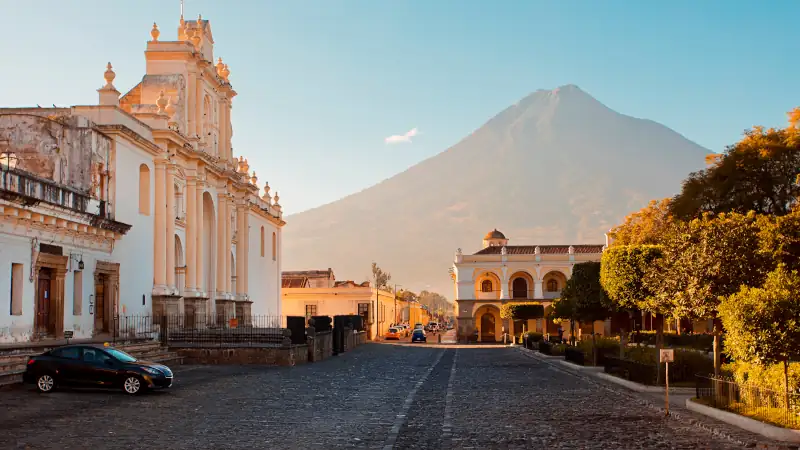
Antigua is a vibrant, living, 16th-century colonial monument full of history, art, culture, and language education. This World Heritage City is a place full of friendly people from many different nations who have chosen Antigua as their home.
This picture-perfect town is backed with a geographical setting of stunning beauty, and a semi-tropical valley between mountains and volcanoes.
Blessed with year-round springtime temperatures, a solid English-speaking expat community, inexpensive yet excellent medical care, great restaurants, and ample cultural activities, it’s not hard to see what has drawn the crowds to Antigua.
Antigua’s religious history is constantly on display in the dozens of ruins of churches, monasteries, and convents scattered throughout the town.
The landscape around Antigua is a mixture of coffee fincas (plantations) and forested areas of pine and silk oak. Making for hundreds of beautiful hiking trails just a stone’s throw from the city.
Lake Atitlán
Considered amongst many the most beautiful lake in the world, Lake Atitlán is not a bad place to lay your hat.
For instance, this stunning volcanic lake is one of the most popular tourist attractions in Guatemala, and has a lot to offer to those who settle here.
Numerous villages surround the edges of Lake Atitlán. One popular amongst expats is Panajachel.
Expats choose to settle here because of the gorgeous weather (this area is often nicknamed “the land of eternal spring”), the low cost of living, and the extraordinary surroundings.
In the villages surrounding the lake, such as Panajachel, you will find everything you need: markets, shops, libraries, medical centers, and restaurants. Spend the rest of the day enjoying water sports, hiking, or simply taking in the incredible views.
Interactive Map Of Guatemala
Click on any highlighted city or region to explore in-depth guides on what life is like there—from cost of living and climate to culture and real estate opportunities. Each location featured is one we’ve carefully reviewed and consider among the most livable and investment-friendly spots in Guatemala. Use this map as your starting point for discovering where in Guatemala your ideal lifestyle awaits.
Where Is Guatemala Located?
Guatemala is a rising star among adventurous expats and retirees looking for a warm climate, rich culture, and affordable living—surrounded by natural beauty and colonial charm.
Roughly the size of Tennessee, Guatemala offers a diverse landscape that includes volcanoes, lakes, rainforests, and coastal lowlands.
When looking at a map of Guatemala, you’ll see it boasts coastlines on both the Pacific Ocean and the Caribbean Sea, totaling over 400 kilometers of shoreline.
Located in Central America, Guatemala is bordered by Mexico to the north and west, Belize to the northeast, Honduras to the east, and El Salvador to the southeast.
Its Pacific coast lies to the south, while a small stretch of Caribbean coastline sits to the northeast, near Puerto Barrios.
A bit of Guatemalan history: Guatemala is the heartland of the ancient Maya civilization and still preserves many archaeological sites and living indigenous traditions. It became independent from Spain in 1821 and has since evolved into a culturally rich and ecologically diverse nation.
Above all, Guatemala is known for its highland towns, colorful markets, and iconic natural landmarks like Lake Atitlán and the active volcanoes surrounding Antigua.
The country is also famous for its vibrant indigenous cultures, colonial architecture, and biodiversity-rich national parks.
Airports In Guatemala
Firstly, Guatemala’s main international gateway is La Aurora International Airport in Guatemala City. It handles most of the country’s international traffic, while Mundo Maya Airport in Flores serves visitors heading to the ancient ruins of Tikal.
Secondly, Guatemala lies just south of Hurricane Alley and can experience tropical storms during the rainy season, though the highland areas are less affected. The country has a wide range of microclimates, from temperate highlands to tropical lowlands, offering something for every preference.