



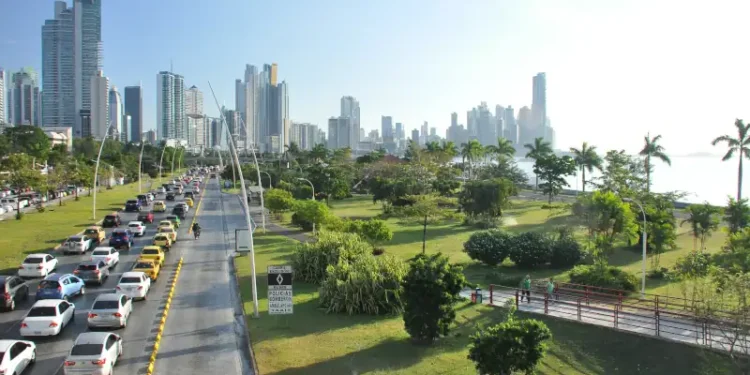
I once saw a woman drive into an open storm drain. Her left front tire got stuck entirely inside.
It was downtown Panama City. Rush hour. Blinding rain.
Storm drains in this city often don’t have covers. In driving rain, you can miss the holes.
That woman’s car wasn’t going anywhere. Water levels in the street were rising, as they can do when it storms in Panama City because drainage systems are often clogged.
Horns blasted. Drivers shouted out open windows.
The woman got out of her car, stood in water above her ankles, laid down her head, and pounded her fists on the hood of her vehicle. I couldn’t hear through the rain, but I figure she was crying.
Our evening commute was delayed two hours.
A couple of years later, on another stormy rush-hour afternoon, I drove beneath the overpass onto Avenida Balboa. Fourteen lanes of traffic converge here from six directions.
The Panamanian drivers around me did what Panamanian drivers do. They attempted to defy the laws of physics while ignoring the rules of any road and all common sense. I was squeezed from every side including by two Diablo Rojos.
Over the decades, 1970s U.S. school buses have made their way down to Panama. Each is privately owned. Each entrepreneur pimps out his ride…
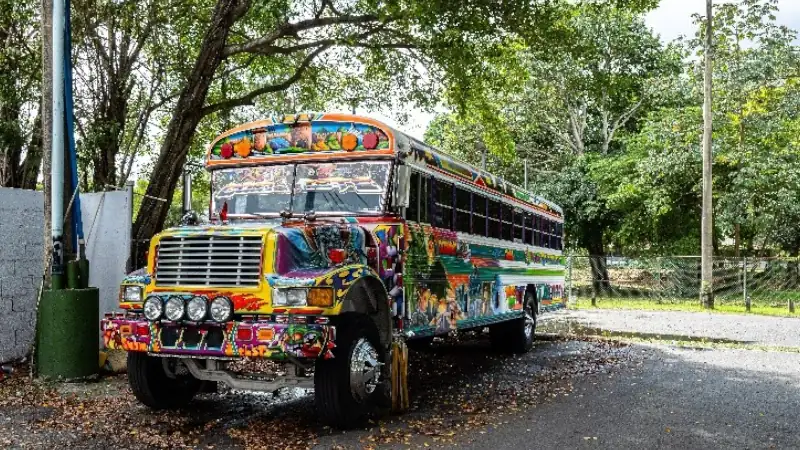
Then makes a business of it. By day these are local buses. By night, mobile party venues. There aren’t many left on the road today, but when we were first living in Panama City, these Red Devils terrorized the streets.
When one of these drivers wants to occupy the space you happen to be occupying… well, there isn’t much for you to do but get out of his way.
As one Diablo Rojo bore down on me from the right and another from the left, my father’s refrain from when he taught me to drive cried out in my head.
“When in doubt,” he’d tell me, “stop!”
I was still. The chaos around me carried on. Somehow nobody ran into me.
I regained my composure, made my way home, and parked my car. I have not driven in Panama City since.
We hired a driver.
Guillermo schooled me on the ways of Panama City’s mean streets.
“You’ve got to drive like a cowboy, Señora Kathleen” he told me one morning after I’d told him he didn’t need to cut continuously back and forth from lane to lane. I wasn’t in that great a hurry I assured him.
“If I don’t drive like this,” Guillermo assured me, “everyone will take advantage of us.”
It was a lesson in Panamanian drivers but also my introduction to juega vivo. Guillermo quit two months later. He moved his young family to Aguadulce. He’d had enough of playing the game of life in Panama City. He wanted to raise his children in the country. I thought he was on to something.
We hired our second driver, Alberto, just before Carnival that year.
“Are you staying in the city next month?” Alberto asked driving me to work one morning.
It would be our first Carnival in Panama. Every previous year since we’d been calling Panama home, we’d taken advantage of the all-hell-breaks-lose-in-this-country holiday to schedule trips outside the country.
“We haven’t decided yet,” I told Alberto.
“If you’re going to travel to the interior,” Alberto advised, “go early. Don’t wait until the weekend before.”
“The traffic will be bad?” I asked.
“You’ve never seen anything like it,” Alberto said.
You mean it could get worse?
I’ve been living in Panama full- and part-time for 20 years.
I named its highlands town Boquete as the world’s best place to live or retire overseas in my 2026 Retire Overseas Index.
I’ve based my business here, and I have invested more in Panama than anywhere else in the world.
I recommend Panama more strongly right now than at any point over the 30 years since I recommended it for the first time.
But some things about Panama I really don’t like. Top of that list is the traffic in Panama City.
Same could be said about anywhere. No place in this big beautiful world of ours is perfect. The key is to find the place that checks your priority boxes.
What’s most important to you?
Make a list. No kidding. Take out a piece of paper and a pencil and write down the three or four things your dream life features.
Then go in search of places that deliver on those scores.
Each one you identify will have downsides. The 80/20 rule comes into play.
The point is don’t compromise on what matters to you… but be flexible otherwise.
For this strategy to work, you need a full and honest assessment of every destination you consider.
Whatever your live-, retire-, invest-, go-overseas agenda, I believe Panama should be on it. For the reasons we discuss all the time.
Meaning you need an honest assessment of what it’s really like to spend time and money in this country.
That’s where my team and I come in.
You won’t get this kind of insider honesty anywhere else.
And you need it.
Until next time,