





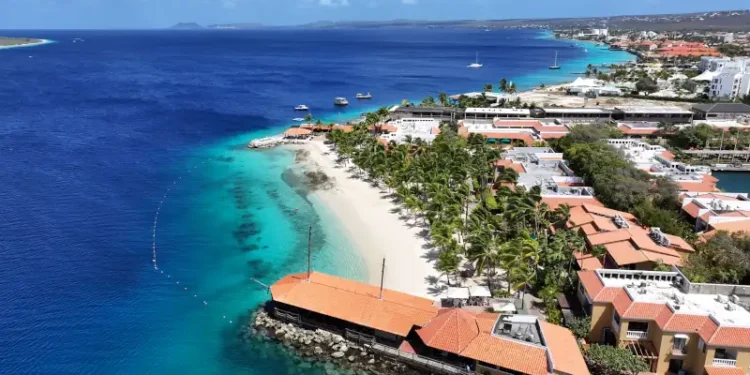
Imagine a land where warm winds blow over giant cacti and rose-colored waves, a place where fairytale flamingos arch their necks over mangroves… wandering goats and donkeys roam freely in the shadow of soaring kites… and golf carts and buggies zip past colorful townhouses and cafés.
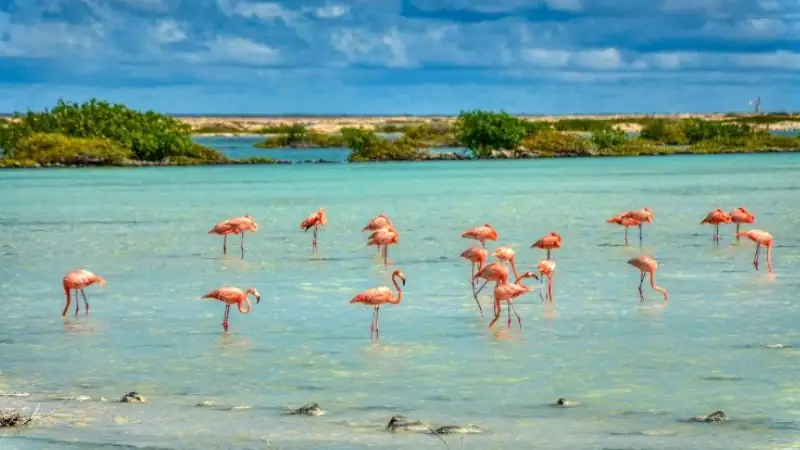
It sounds like a child’s dream.
And this is the curious juxtaposition that is Bonaire. The Antillean island is a unique combination of Dutch sensibilities and Caribbean ease, a blend of old and new, rugged and chic, magical and practical.
Bonaire will surprise you.
To get here, you’ll fly south, past the Bahamas, Caymans, and the British Virgin Islands, to today’s Dutch Caribbean. Although a favorite among Nederlanders (who fill up the daily flights from Amsterdam), Bonaire is just south enough to be overlooked by many Americans looking for a Caribbean vacation. So south, in fact, that it happily lies just outside the hurricane belt. The weather you might worry about in most places in the Caribbean isn’t a concern here.
As we arrived, our pilot warmly welcomed us to “the prettiest of the ABCs, with the nicest people.” Bon bini!
It’s a veritable alphabet soup of islands in this part of the Caribbean. The northern SSS islands are Sint Maarten, Sint Eustatius, and Saba, and the southern ABC group includes Aruba, Curaçao, and Bonaire.
In 2010, the Netherlands Antilles separated into the three self-governing countries of Aruba, Curaçao, and Sint Maarten (the CAS Islands) and the special municipalities of Bonaire, Sint Eustatius, and Saba (the BES Islands). Today those last three are now specifically referred to as the Caribbean Netherlands.
Bonaire, while historically most identified with its ABC neighbors, is actually a separate political entity among them. Ruled by the Netherlands, it’s the only one of the three ABCs that isn’t autonomous. When you arrive in Bonaire, you have the pleasant sensation of arriving in a warmer, slow-paced Netherlands.
The lovely dichotomy of European vogue and Caribbean wild seems to work here. Additionally, the last 15 years as a Dutch municipality has allowed Bonaire to enjoy some significant Dutch perks, including improved health care and educational facilities and fries with mayonnaise, while preserving its island culture.
“Bonaire is a gem—but you do need the right mindset to move here,” says expat Stacy Olson. “Most people start as tourists and then fall in love with it—which is what happened to me.”
While an estimated 80% of the population are Dutch nationals, 60% were born in the Antilles Islands and Aruba. Many others are of African descent, as well as those from South and Central America. English, Dutch, and Spanish figure prominently, and Papiamentu and Dutch are both official languages. But, sure, everyone speaks English. Even the currency is American dollars.
Bonaire is likely best known for its scuba diving. Rightfully so: Its reefs are teeming with fish. What makes Bonaire unique, however, is how accessible they are.
Beyond scuba diving, snorkeling, boating, fishing, and clear-bottom kayaking on Bonaire are sports I’d never even heard of… land sailing, wing foiling, wind foiling… All are very entertaining and enjoyed by all ages. Don’t be surprised to see children learning to navigate the wind and waves alongside octogenarians.
Bonaire’s consistent winds have also caught the attention of sports enthusiasts. Name a wind sport, and they’ve got it here. Lac Bay, where calm waters and trade winds were once a refuge for ships and are today still home to sea turtles, mangroves, and seagrass, is an established mecca for windsurfers.
Spend an afternoon at the bay’s Jibe City, where beginners are wave-riding, experts are soaring, and others are shopping or enjoying a baguette and tuna tartar for $27.50. You can windsurf for an hour for $35 and foil for $50; a beginner windsurf lesson is $50 (plus $30 for rental) and wing lesson $125, including equipment.
One of the best things about Bonaire is its universal, publicly funded free health insurance. Thank you, Netherlands. Once you have your sedula, you’ll apply for health insurance with Zorg en Jeugd Caribisch Nederland (ZJCN), or the Care and Youth Caribbean Netherlands, who will hand over a physical health card. After that, simply register with a primary care physician. It really is that easy.
Plus, health care is good, and Bonaire’s Fundashon Mariadal Hospital is equipped to handle most emergencies. It even has a fully operational recompression chamber for dive-related situations. The Bonaire Medical Center General Practice also offers a range of services and consultations, as does an after-hours general medical practice.
Sincerely,
Siri Lise Doub
Contributor, Overseas Living Letter