Understanding Panama’s Tropical Climate and Seasons
Panama has a tropical climate, and being close to the equator, the temperature does not change much throughout the year.
Many people new to the tropics think those living on or near the equator enjoy a climate of perpetual heat with little or no seasonal variation. While, yes, the heat is par for the course year-round, we do indeed have seasonal changes that residents or potential newcomers must prepare for. The temperatures may not vary much between seasons, but the climate most certainly does.
Panama’s climate differs from that of North America, featuring just two seasons instead of four: the dry season and the rainy season. Most importantly, different parts of Panama do have different climates, and that can influence the location you choose to retire in Panama.
In Panama, you can experience a rare phenomenon: the sun rises over the Pacific and sets over the Caribbean, making it the only place in the world where this occurs.
At specific high points, you can even catch a glimpse of both oceans at once. This extraordinary sight is made possible by Panama’s isthmus, which is less than 40 miles wide at its narrowest section.
Panama’s Dry Season
From January to April (or thereabouts—sometimes rain stops in December, and sometimes it’s early or late to return), Panama enjoys its dry season; it’s typically called summer locally. For these three to four months a year, the country receives very little rain, if any at all. This is when most travelers flock to the country.
But the differences are also more subtle: We eagerly welcome a decrease in humidity, an uptick in coastal breezes, and an extra hour to hour and a half of sunshine per day (the sun rises 30 to 45 minutes earlier and sets that much later, too). Plus, of course, lots of unadulterated sun.
Panama’s summer is consistent and dependable—you’d never have to cancel your golf plans or beach weekends so long as they fall between these months. Panamanians take full advantage and like to hit the islands and coastlines without fail every weekend. (This is also when traffic from the city to the nearby beaches is at its worst.)
There are downsides to the long-awaited dry season, though.
To state the obvious, things get, well… dry! After several months of no moisture, the country is a dustbowl, unpaved roads are a nightmare to drive on if no water truck comes to regularly tamp down the loose soil, and Panama’s usually verdant green countryside turns an unpalatable brown.
By the time the rains are rolling back in, many welcome it.
Panama’s Rainy Season
From April or May to December or so, the rainy season (also called the wet season) sets in. During this time—the majority of the year—you can safely expect a downpour per day; drenchings may last mere minutes but could also last a couple of hours. Early months, say, from April to August, may not see rain at all—but you’d be wise not to count your sunny days before you see them. Storms usually occur in the afternoon, and often the sun shines bountifully before and after.
At the height of the season, though—November and December, say—you can almost set your watch by the thunderstorms, and entire days tend to be overcast. You might even see the occasional all-day storm during these months—a true rarity in the tropics.
Most people, like anywhere with seasons, find things to love and look forward to in each change of climate.
Average daily temperatures won’t change all that much during the rainy season, but cooling winds die down and a blanket of humidity settles over the country—truly, the rise in humidity is something not to underestimate. At times, the air can be akin to that of a hammam… a simple stroll around the block can seem like a sweat-soaked tour of duty on cardio equipment. The humidity this time of year can be oppressive, no getting around it. Keep in mind, though, that the climate is also highly changeable… one hour feels like wading through a steam room, the next may be much lighter.
And then, of course, there’s the rain. It often comes down hard and fast with little warning. Many a jogger or biker has been caught out in a storm… you can try to plough through it, but often you’re forced to stop for at least the worst 10 or 20 minutes of it—unless you’ve got goggles and decent skin protection. The drops can be so fat and come down so heavily that trying to power through becomes painful and even dangerous.
Once you learn the tropical seasonal patterns and get used to them, life becomes less a crapshoot and more just a thing to prepare for. Carry an umbrella and spare shoes at all times for the rainy season. If you go out running, carry a Ziploc to protect your phone and money from the water. And know that the skies are going to open up at some point in the afternoon, meaning you should do your outside chores in the morning and try to stay within sprinting distance of shelter in the hours between lunch and dinner.
By no means should you let the wet season rule your life—there’s no reason to hibernate for these overcast and unpredictable months. Wondering what all there is to do that won’t get rained out? This survival guide puts the best of Panama’s indoor opportunities at your fingertips.
Climate In The Different Regions Of Panama
Climate In Panama City
The daytime temperature is around 86 degrees Fahrenheit. At nighttime, the temperature drops to around 75 degrees Fahrenheit.
During the summer months, Panama City averages between 7 and 8 hours of sunshine each day. During the rainy season, the amount of sunlight is between 5 and 6 hours.
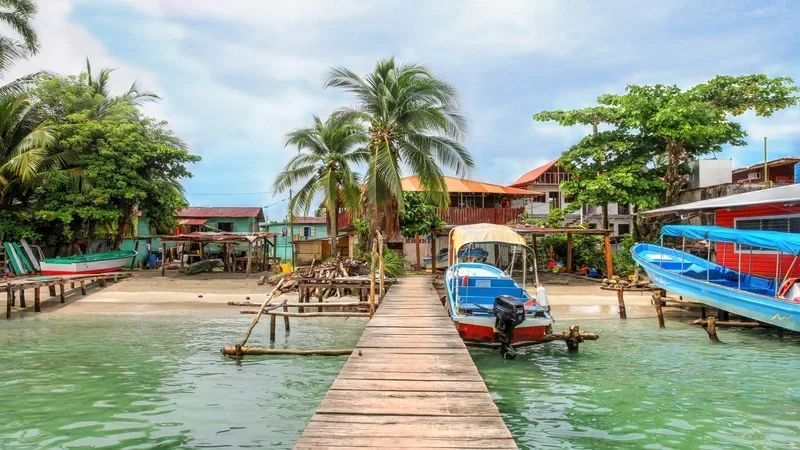
Climate In Bocas Del Toro
The average daytime temperature in Bocas Del Toro is around 80 degrees Fahrenheit. Bocas Del Toro receives over 300mm of rain during the months of June, July, and November. These are the wettest months in Bocas Del Toro.
Climate In Boquete
The average daytime temperature in Boquete is around 33°C (91°F). Although nights are cooler here, the temperature seldom gets below 10°C (50°F).
During the months of June and July, Boquete receives over 400mm of rain and, even during the dry season, receives over 160mm of rain per month.
Getting Around Panama City While Keeping Dry
Panama City is one of the least walkable places in the world… at no time more dangerous than during the height of the rainy season.
Nearly every hotel, mall, residential building, and business establishment has inexplicably paved its entryways, surrounding sidewalks, and outdoor pathways in marble, porcelain, or some other kind of highly polished tile. If you’ve been to Panama and stayed at a hotel, you’ve no doubt noticed the beautiful exterior tiling.
Beautiful, but completely impractical. Treacherous, even.
When these kinds of ceramic tiles get wet, they are slippery. And when are they not wet in Panama, except maybe a couple months in the dry season? Rain isn’t the only factor… the unrelenting humidity adds to the problem. And, of course, these floors are mopped with water and cleaner daily.
The entire world has been plagued by wet-floor slip-and-fall accidents, resulting in serious personal injury to clients, customers, employees, and the general public passing by… but Panamanians don’t seem concerned.
Panama’s prolific traffic might make walking seem like a good option, but often it’s more hassle than it’s worth—especially in the rainy season with its sometimes lake-sized puddles.
Luckily, there are plenty of other options for getting around town while keeping dry… and safe!
Uber
In the last couple of years, mega-app Uber has arrived in Panama, and it now represents the absolute best option for rainy-day transportation. With Uber on your smartphone, you can text for a driver at any time and have him meet you wherever you are, no matter the weather. No more waiting on a street corner in the rain hoping to find an empty cab willing to pick you up… no more sprinting to the metro station… no more standing like a sardine among several dozen under the bus-stop shelter.
Metrobus
The next-best option for dry transport after a ride-hailing service is the local bus system.
With lots of stops in the inner city and surrounding neighborhoods, you won’t have to run too far to get to a bus… though you may have to wait longer than you might like if it’s raining—and not every stop always has a shelter to take cover under.
That said, the Metrobuses in Panama City are clean, air-conditioned, and easy to use. They are also super affordable. Buses are regular and routes are online here.
Metro
The metro is a great way to get around and keep dry if you happen to live near a station and are going somewhere that is also near a station.
The Panama Metro is the first rapid transit system in Central America and opened in April 2014.
Metro carriages are clean, spacious, and air-conditioned. Digital signs on the platforms alert passengers to train arrivals, and upcoming stations are announced inside the trains.
Taxis
Taxis may be the worst of all options for a rainy emergency. The most obvious reason is that they may or may not take you depending on where you’re going… or their mood. It’s illegal for a taxi to refuse a fare, but it’s far more common to be refused (“no voy”) than it is to be accepted.
In the rain, the odds are even worse. It’s hard in the rain to find an empty cab at all, but even an empty one might refuse you. On the other hand, drivers may also decide to capitalize on the misfortune of wet pedestrians, deciding to pick up as many drenched customers as possible. While this is fairly normal operating behavior for taxistas down here, we advise strongly against it. At the most benign, they don’t drop off on a first-come, first-served basis, so while you may have been first in the car, the driver could make five detours to drop off all your fellow passengers first, costing you time and not even discounting your rate.
More superficially, cabs might not keep you as dry as you’d like. Taking a taxi in hectic Panama City is a mixed bag. Sometimes you’ll have a safety belt or air conditioning… other times there’s a window that won’t close (or a plastic bag taped in its place) or a door held shut by a rope or wire. In these cases, you’re still at the mercy of the elements.
Climate in Panama FAQ's
What is the coldest and hottest month in Panama?
April is the warmest month at the Panama Canal, with an average temperature of 29°C (83°F). October is the coolest month, with an average of 26°C (79°F).