
FREE 3-PART MASTERCLASS
Watch The Free Panama Masterclass Today!
Simply enter your email address below and watch 3 unedited, on-demand streaming sessions with local lawyers & expat specialists.

Panama City Beaches Areas are conveniently an hour-and-a-half from Panama City. We share all about their cost of living, infrastructure, etc.

Panama City Beaches are just a short hour-and-a-half drive from the heart of Panama City. Here are some insights into their cost of living, infrastructure, and much more.
You can drive out from Panama City after work on Friday, enjoy a weekend at the beach, then return to the city Sunday evening in time for the work week, and that’s precisely what every Panamanian living in Panama City who can afford it does.
To Panama City residents, the City Beaches are close enough for quick weekend trips but far enough away to forget the stress and commotion of the city.
And, to residents of the City Beaches, the capital offers a level of nightlife, a variety of dining options, and cultural events not available at the beaches.
Getting here from outside the country will most likely involve a flight to Tocumen International Airport. Then, your options include bus, private transport, or a car rental. Traffic in Panama City is heavy, and there’s a lot of construction. Waze will be your best friend, so I recommend a good roaming plan. You can alternately purchase a SIM card and prepaid minutes at the airport.
If you’re a resident of Canada, you may have the option of flying into Scarlett Martinez International Airport in Rio Hato (RIH). This is arguably much easier, but service is limited to seasonal charter flights. Air Transat and Sunwing Airlines currently fly into Rio Hato. There is no Uber in the Coronado area, but there are rental car companies and taxis.
Explore how the healthcare system works in Panama, what expats typically do for coverage, and what to expect for day-to-day care—so you can plan with confidence before you move.

The cost of living is higher than many destinations in Panama due mostly to the location and accessibility of Panama City. For instance, a couple can live and retire well on US$2,440 per month here.
Panama uses the U.S. dollar.
| Expense | Monthly Costs | Notes |
|---|---|---|
| Mortgage | – | Not included here as too variable. |
| HOA Fees | US$150 | Average. |
| Property Taxes | – | Not included here as too variable. |
| Transportation | US$15 | Occasional taxi or Uber. |
| Gas | US$8 | Per tank. |
| Electricity | US$150 | Average with air conditioning. |
| Water | US$20 | |
| Cell phone | US$35 | Tigo prepaid minutes. |
| Internet | US$40 | Depending on the location, it could be more. |
| Cable TV | US$36 | |
| Household Help | US$45 | Cleaning once every two weeks. |
| Entertainment | US$156 | Eating out twice a week at a mid-range, local restaurant (US$120), local drinks twice a week at a nearby watering hole (US$8), movie theatre trip twice a month (US$10). |
| Groceries | US$400 | Basic items for a couple. This includes beer, wine, and some imported organic foods. |
| Gym membership | – | |
| Medical Appointment | US$20 | Basic checkup in a public hospital. |
| TOTAL | US$1,071 |
| Expense | Monthly Costs | Notes |
|---|---|---|
| Rent | US$900 | In a desirable part of town (city center, if applicable), furnished, two-bedroom, comfortable apartment. |
| Transportation | US$15 | Occasional taxi or Uber. |
| Gas | US$8 | Per tank. |
| Electricity | US$150 | Average with air conditioning. |
| Water | – | Included in rent. |
| Cell phone | US$35 | Using Tigo prepaid minutes. |
| Internet | US$40 | Depending on the location, it could be more. |
| Cable TV | US$39 | Included in internet price. |
| Household Help | US$45 | Cleaning once every two weeks. |
| Entertainment | US$152 | Eating out twice a week at a mid-range, local restaurant (US$120), local drinks twice a week at a nearby watering hole (US$6), movie theatre trip twice a month (US$10). |
| Groceries | US$400 | Basic items for a couple. This includes wine, beer, and some imported organic foods. |
| Gym Membership | – | |
| Medical Appointment | US$20 | Basic checkup in a public hospital. |
| TOTAL | US$1,820 |
| Expense | Monthly Costs | Notes |
|---|---|---|
| Rent | US$400 | Cheapest part of town (still desirable), most basic one-bedroom rental. |
| Transportation | US$15 | Occasional taxi. |
| Gas | US$8 | Per tank. |
| Electricity | US$40 | Without air conditioning. |
| Water | US$15 | |
| Cell Phone | US$20 | No plan. Just buying pre-paid cards when needed. |
| Internet | US$23 | Basic internet. |
| Cable TV | US$14 | Most basic cable. |
| Entertainment | US$40 | Eating out once a week at a local restaurant. |
| Groceries | US$250 | All local-brand items only, shopping markets and local vendors along with grocery stores. |
| TOTAL | US$825 |
Get a clear breakdown of everyday expenses in Panama—including housing, utilities, groceries, transportation, and healthcare—so you can budget accurately before you make the move.

While the spots on this coast developed two or three or more decades ago can sometimes be described as “basic” when it comes to amenities and infrastructure, the newer developments are increasingly high-end.
For example, JW Marriott put its name to what is without a doubt the nicest resort property not only in this part of Panama but anywhere in the country.
In other words, the City Beaches are coming of age, and, as they mature, the options they include are of a markedly higher standard.
Nowhere else in Panama would the living or retiring be as easy or as convenient.
You’re an hour-and-a-half (give or take) from Panama City, meaning you can return to the big city for supplies, shopping, and nightlife whenever you want. However, you can also find almost everything and anything you might need or want locally now, as well.
The shopping and dining options, specifically in Coronado, are expanding all the time.
Coronado has steadily grown and now has first-world amenities at cheap prices. If you’re looking for a beach-resort lifestyle with low prices and plenty to do, Coronado, Panama, is the place for you.

Car break-ins aren’t a huge problem but they do happen here, particularly at a small number of public parking areas. You don’t have to avoid these areas entirely. You just need to take some simple precautions.
For instance, park your car where it can be easily seen by neighboring homes or businesses, and keep the inside tidy

The Panama City Beaches are hot and humid. But residents also enjoy the convenience of the cool, rejuvenating air of Panama’s highlands nearby.
For example, lovely El Valle (another former weekend getaway turned full-time community) is only 30 minutes away, making spontaneous day trips possible whenever the need for a break from the heat of the beaches arises.
Panama has yet to become the worldwide mecca for surfers that Costa Rica is, even though its Pacific Coast waves often are on par with those of its neighbor. But that’s a good thing. In other words, the waters are much less crowded than Costa Rica.
The best time for surfing the Pacific Beaches is generally April to June, when offshore winds kick up fairly consistent swells. In some places they can actually get too big for beginners that time of year.
During the November-to-April dry season (“summer” in Panama parlance), the winds are generally lighter and the waves slightly calmer.
Get Your Free Panama Report Today!
Simply enter your email address below and we’ll send you our FREE REPORT – Live And Invest In Panama: The #1 Retirement Haven In The Americas.
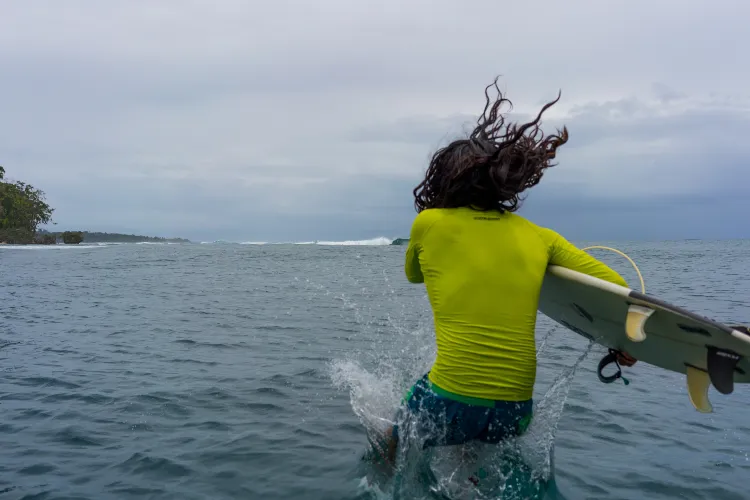
Panama has yet to become the worldwide mecca for surfers that Costa Rica is, even though its Pacific Coast waves often are on par with those of its neighbor. But that’s a good thing. That means the waters are much less crowded than Costa Rica. It is, however, starting to attract more and more attention on the surfing stage and has even hosted a couple of international competitions in recent years.
Santa Catalina and the rest of the Azuero Peninsula, especially Playa Venao on the southeast coast, get most of the attention from surfers in Panama, but those spots are probably a bit ambitious for folks like me who are just dipping their toes into the water. The place to get started is most definitely the City Beaches west of Panama City. There are schools to help you get your bearings, the swells are usually smaller and less intimidating, and the accommodations for those who are spending more than a day at the beach are not quite as rustic as they are at out-of-the-way spots on the Azuero Peninsula.
The best time for surfing the Pacific Beaches is generally April to June, when offshore winds kick up fairly consistent swells. In some places they can actually get too big for beginners that time of year. During the November-to-April dry season (“summer” in Panama parlance), the winds are generally lighter and the waves slightly calmer.
Surfing neophytes will likely want to head straight to Playa El Palmar, outside the town of San Carlos and about 10 kilometers west of Coronado. Because it’s only about an hour and a half from Panama City, it’s a popular place and can get crowded on the weekends, but weekdays you won’t find much competition for the waves. There are even a couple of schools at Palmar—Panama Surf School among them—where for US$60 a pro will help you get up and dropping into the faces in no time (in a two-hour private lesson).
This a beach break with a nice, soft sandy bottom for those times you inevitably tumble from your tabla (Panamanian Spanish for surfboard). Most importantly, beginners will want to check here first, especially on a low to medium tide, and dive right in if the swells are there. The rides can be short, but fun.
If the tide is high, head for this spot to the right of the beach break. It’s a rocky bottom and the swells can be larger than the front so beginners may want to tread lightly here, but those with experience will appreciate the powerful waves here.
This one is also close to the Palmar area. Most importantly, it’s often less crowded than the point or the front (especially on weekends). And, it’s also a rock bottom and ideal when the swells are around four feet or less at high tide.
Further west down the road from Palmar is Playa Rio Mar, where two breaks dominate—the Frente Rio Mar (Rio Mar Front), a beach break that goes both left and right, that is best at medium to high tide, and Punta Rio Mar (Rio Mar Point), about a mile down the beach, near a long rock ledge where the waves break predominantly at low tide.
In the direction of Panama City near the town of Gorgona is one of the best and most consistent spots in the Panama City Beaches.
The waves break to the right along a sandbar at the mouth of the Chame River. And, look for some lovely tubes here on a good day, but beware of debris in the water drifting out from the mouth of the river (especially after a heavy rain).
Another river-mouth spot, also near Coronado, the main attraction here is the long lefts at low tide at the front and the tubes and long rides on incoming tides at the point. Nearby Rinconsito, named after a famous break in California, is known for a right break that can stretch as long as 183 meters under the right conditions.
Explore top living destinations, beach communities, highland havens, and city hubs across Panama.
Practical guidance for planning your life, move, retirement, property purchase, or investment in Panama.
Panama’s seafood traditions bring together the flavors of the country’s two coastlines, with recipes that make the most of the fresh catch. Two local…
Read InsightAI has no role at Live and Invest Overseas. Every time we allow AI into the conversation, we give up a little piece of your trust—and trust is the foundation of everything we do. Our strength is simple: real people speaking from real experience, in first person, telling real stories from the ground.
We will never publish AI-generated content. Not from ourselves, and not from anyone submitting to us. Our work is built on judgment, experience, trust, and what’s actually happening on the ground—not scraped summaries or recycled internet information.
When you read us, you’re reading lived experience. The stories, the insights, the perspective—that’s what AI can’t touch. And that’s exactly why we don’t use it.
Top Countries
Budgets
Resources
Real Estate
Conferences
Store
Free Report
© 2008 - Live and Invest Overseas - All Rights Reserved.